Traveling six hours on the train took us from Mumbai, India to Araugabad specifically to visit the UNESCO World Heritage sites of the Ellora and Ajanta temple caves. It was well worth the trip. These temples are amazingly beautiful and a testament to the people’s religious commitment.
While in Araugabad we were looking for a place to buy fruit for our upcoming 24 hour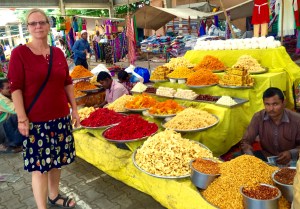 bus trip to the city of Udaipur and were directed this bustling, colorful outdoor market. We went hog wild buying apples, carrots, cucumbers and tomatoes. We sure wished we had a kitchen to try out all this great produce and yummy spices.

Our first day of touring was to the Buddhist cave monuments of Ajanta. The approach to the Ajanta caves is stunning because the temples are carved into a horseshoe shaped 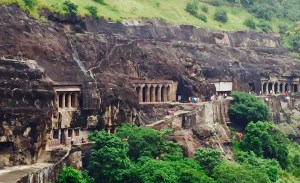 mountainside with a waterfall at the end of the gorge. The 34 rock-cut Buddhist cave monuments were constructed from around the 2nd century BC to the 6th century AD. These caves include paintings and rock chiseled sculptures of Buddha and other deities. One of the primary reasons to visit Ajanta is to admire its renowned ‘frescoes’ which adorn many of the caves’ interiors.


Ajanta was deserted for about a millennium, as the Deccan forest claimed and shielded the caves, with roots and shoots choking the sculptures, until 1819, when a British hunting party stumbled upon it purely by chance.
Day two of touring took us to the monastery-temple caves of Ellora. It is one of the  largest rock-cut complexes in the world. It was especially interesting because the site presents monuments and artwork of Buddhism (12 caves), Hinduism (17 caves) and Jainism (5 caves) created from the 600 AD through 1000 AD. Each group shows the respective deities and mythologies of that time, as well as the monasteries of that religion. They were built near each other and demonstrate the religious harmony prevalent in ancient India. The site features over 100 caves, of which only 34 caves are open to public.
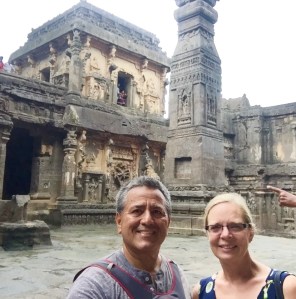 Cave 16 of Ellora features the largest single monolithic rock excavation in the world, the Kailasha temple. The surrounding rock was excavated from top to bottom and scooped out from the outside to the inside. Ten generations worked for over two hundred years to complete this monument. The temple is dedicated to the Hindu God Shiva and throughout the structure are carvings of the various gods and animals. We especially liked the elephants.


When the temples were constructed, Ellora was an important historic commercial center of the Deccan region, located on an ancient trade route of South Asia and the caves served as monasteries for monks, temples for prayers and a place for pilgrims to rest.
One of the striking things about India is the amount of litter and piles of garbage that is strewn throughout the cities. So many places we have been are extremely scenic and beautiful but are marred by the trash. In India, if you are finished with a water bottle just throw it out the window of the bus or sitting in a park with a snack just drop your packaging on the ground. Much of the population have no concept of keeping the environment clean. We met a very nice retired couple at the Ellora Caves and had a conversation with them about the litter issue. According to them, there is an effort to try to change people’s behaviors. They said that the Prime Minister has given many speeches about the issue. So far it seems to have had little impact.
We enjoyed touring the cave temples a lot even though all of the stairs were hard on Mike’s sore knees.
 Travel the World Backpacking
Amazing!
I met you both at the bus parking when you were catching a bus to Ahmedabad I guess. After the Rs.500& Rs.1000 notes lost their legal tender status, I was thinking of you guys if you might be having any problems. Glad to see you are back home with happy memories. Love 🙂
We paid our hotel bill with 500 and 1000 notes as we left for Cairo and a midnight that night they were worthless. We spent them just in time.