The entire west coast of South America and much of the Andes were
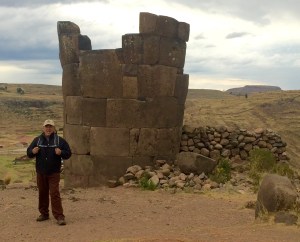
Funery Tower – Burial Sites
conquered by the Incas. As we headed south toward Lake Titicaca and the city of Puno we saw much evidence of the Inca civilization along with those who proceeded the Incas.
Lake Titicaca is a large, deep lake in the Andes on the border of Peru and Bolivia. It is the largest lake in South America and at an elevation  of 12,507 feet (we were breathless) it is the highest navigable (by commercial ships) lake in the world. Puno is the coldest city in Peru and although it was summer we were bundled up in layers of jackets with hats and gloves.
Our tour of Lake Titicaca included a visit to the floating islands of the Uros people. Six hundred years ago the Uros tribe was driven off the land and onto the lake by the conquering Incas. They rowed onto the lake in their reed boats and there they lived. Because they could not return to the mainland the Uros developed a method of building floating islands out of the fast growing reeds and their roots. The profusion of reeds sustain the Uros with construction materials and food. The mayor of the island we visited (that’s him in the hat) demonstrated how the islands are built with bales of roots tied together and covered with layers of reeds laid in a crisscross pattern. The layered reeds have to be replaced every fifteen days so it is a constant effort of maintenance.


The island we visited has five families with twenty-two residents. Each island has a “mayor” who is the leader. If you can imagine, walking on the island is like walking on a mushy floating dock. The men spend their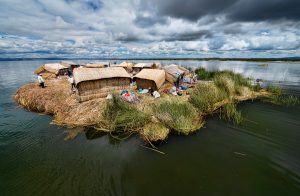 days fishing while the woman create handicrafts to sell to the tourists. The children go to schools built on one of the larger islands. There is no running water, they use the water out of the lake. The islands recently received solar power through a government so there is power for lights at night. Some of the more visited islands have a larger reed boat for taking tourist visitors on a ride. The ride costs ten Peruvian nuevo sol ($3). The boat we rode in is called the Mercedes Benz.


During the mid 1980s the Uros population was at a high of over 5000 people but today there are approximately 2000 people living on nearly 100 islands. Between the high school aged children being sent to Puno for school and the introduction of technology, it is our guide’s opinion, that the Uros way of life will disappear within the next two generations.
 Travel the World Backpacking