Yesterday we experienced a very solemn tour at the Tuol Sleng Museum of Genocide that was originally the Tuol Svay Pray High School turned prison by the Khmer Rouge in 1976. Of the 14,000 people known to have entered S-21 Prison, only seven survived. The tour was very poignant because the Khmer Rouge carefully transcribed the prisoners’ interrogations and photographed the vast majority of the inmates creating a photographic archive of the men, women and children imprisoned, interrogated, tortured and killed. Using headphones, an audio tour directed us through the prison with stories, interviews and actual trial recordings.
Inside the gates, it looks like a typical high school with five buildings facing a grass 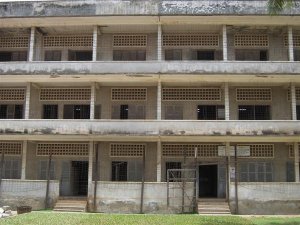 courtyard. The ground-floor classrooms in one building have been left to appear as they were in 1977. The spartan interrogation rooms are furnished with only a school desk-and-chair set that faces a steel bed frame with shackles at each end. In another building the walls are papered with thousands of S-21 portraits. The barbed wire was added by the guards to keep the prisoners from committing suicide by jumping to their death. S-21 was one of hundreds of prisons around the country.


The Khmer Rouge turned the country into a huge detention center, which later became a graveyard for nearly two million people, including their own members and even some senior leaders. A few days after they took power in 1975, the Khmer Rouge forced marched (thousands died) perhaps two million people in Phnom Penh and other cities into the countryside to undertake agricultural work.
They wanted to transform Cambodia into a rural, classless society in which there were no rich people, no poor people, and no exploitation. To accomplish this, they abolished money, free markets, normal schooling, private property, foreign clothing styles, religious practices, and traditional Khmer culture. Public schools, pagodas, mosques, churches, universities, shops and government buildings were shut or turned into prisons, stables, reeducation camps and granaries. There was no public or private transportation, no private property, and no non-revolutionary entertainment. The educated professionals, government officials and religious leaders were the first to die. Many people were worked and starved to death by the regime.
During this time, everyone was deprived of their basic rights. People were not allowed to go outside their cooperative. The regime would not allow anyone to gather and hold discussions. If three people gathered and talked, they could be accused of being enemies and arrested or executed. Between 1975 and 1979, 1.7 million Cambodians are believed to have lost their lives. Survivors remember being told that the revolution would be successful without them: “To keep you is no benefit, to destroy you is no loss.”
Viewing the museum was especially touching because it is such recent history. While all of this was going on I was just finishing high school. I remember hearing about the Khmer Rouge on the news but it didn’t really make an impression. Being here and seeing the museum does make an impression. As does realizing that anyone over age 35 survived during the killing years and seeing the number of people missing limbs because of left over land mines. It has been a sobering visit
 Travel the World Backpacking