Arriving in Siem Reap, Cambodia we found a surprisingly modern city. We were  expecting Cambodia to be more foreign and undeveloped than what we found in Indonesia and Thailand. But Siem Reap, being the home base for visiting the temples of Angkor Wat, has a lot of tourist infrastructure. Our very modern hotel with a pool cost only $19 per night (breakfast included) and was surrounded by many restaurants and shops. Cambodian people are extremely hospitable and welcoming.
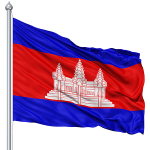 Our Lonely Planet guide book lists Angkor Wat as the number one attraction to see in Southeast Asia so we couldn’t miss it! Angkor Wat or “Capital Temple” is the largest religious monument in the world, with the site measuring 402 acres. It was originally constructed as a Hindu temple but gradually transformed into a Buddhist temple toward the end of the 12th century. It has become a symbol of Cambodia, appearing on its national flag, and it is the country’s prime visitor attraction.
Arriving at Angkor Wat was very mystical as we walked across the moat bridge and 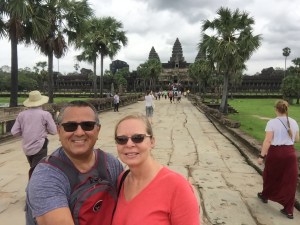 saw the ruins emerge out of the heavily forested area. The Buddhist religion is still practiced in the temple. Buddhist monks are daily visitors and their bright orange robes making a vivid contrast with the grey stone of the temple. I received a blessing from a monk that included a prayer, being sprinkled with holy water and a red yarn bracelet. The temple grounds are so vast, it could take days to visit every gallery and shrine. We took the short tour and were only there a few hours.


The second temple in the Angkor Archaeological Park we visited was Angkor Thom or “Great City”. It was the last and most enduring capital city of the Khmer empire. At the centre of the city is the Bayon, a spiritual monument with immense four-sided stone faces. Angkor Thom is interesting because it is only now being restored and is in a decaying condition. There were several groups working on restoration of the main temple.


No visit would be complete without going to Ta Prohm. Ta Prohm is in much the same 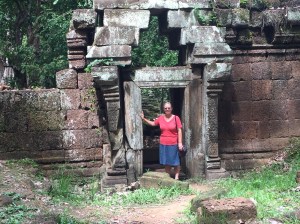 condition in which it was found. The site is a photogenic and atmospheric combination of trees growing out of the ruins and the jungle surroundings. But what really makes it famous is that Angelina Jolie’s Tomb Raider movie was filmed in the area in 2000. Although many sites around Angkor Wat were used in the film, this tree growing over the buildings at Ta Prohm is what draws tourists for pictures. So of course we could not resist.


Our friendly and capable guide, Seng Mong, toured us around the archaeological park all day in his tuk-tuk. Gas is sold at road side stands from liter soda and liqueur bottles. Mike kept saying that riding around was his favorite part of the tour because the moving air was cooling.


 Travel the World Backpacking