“Wonderful Indonesia” is not my tag line, it is the official tourism slogan of the country and wonderful it is. Indonesia is the largest archipelagic nation with over 17,000 islands. Six hundred of the islands are occupied. We will experience 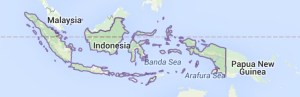 only five of them during our time here. The nation is naturally and culturally diverse. Although Indonesia is near the equator, it’s natural diversity ranges from the snow-capped peaks in Papua to dense jungle in Borneo to impossibly, hurt your eyes green rice terraces in Bali and Java. As an island nation, beaches with snorkeling and diving opportunities are everywhere. Most interesting to me is the mash-up of people and cultures. Each of the main islands have their own culture and language although Indonesian and English are widely spoken. Bali for example, is primarily Hindu with its temples and worship practices whereas Java and Flores residents are mostly Muslims with their mosques and worship.
The practice of Hinduism is subtle but noticeable. Three times a day Hindu worshippers make an offering and pray. On Bali, the offerings are usually made on a 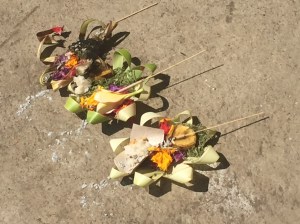 small banana leaf tray. Asking for blessings, offerings can include seemingly random bits of food, grasses, incense, money and a cigarette. They are left at temples, along the ocean or in front of businesses. At the guesthouse where we stayed in Ubud, the owner left offerings on the scooter of each employee asking for the blessing of safe
 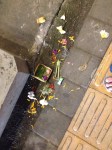 travel. One problem is that offerings left in public places do not get picked up and soon make a trashy mess. In every block of the
 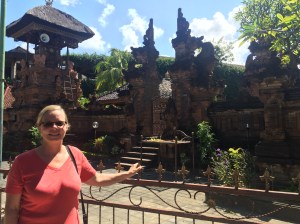 streets of Kuta Beach there is a mixture of centuries old temples side-by-side with new shops, restaurants and hotels.
On the mostly Muslim island of Flores, the religious practices include calls to prayer, mosques and women wearing head scarves. Five times a day the call to prayer is made over an amplified system. We are not loving the pre-dawn call at 5:00 a.m.
Bali is a tourist paradise. Our plane over from Adelaide was packed with Australians 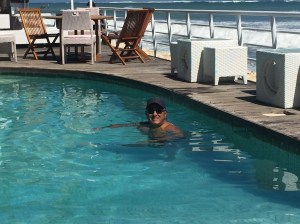 ready for a holiday. Most were headed for the very affordable resorts of beautiful Kuta Beach. We spent several days in Kuta soaking up the sun and taking in the culture. Our hotel was interesting in that it was built into the beach side of a huge shopping mall.
While on Bali we took a tour that included a Barong Dance, two Hindu temples and rice terraces. In the temples we had to cover our legs with sarongs


The Barong is a display of graceful movement and vibrant colour. Presented in five parts, the dance is a contest between the opposing forces of Rangda – chaos and destruction, and Barong – order. It is basically the struggle between good and evil illustrated all in dance. It was a good thing they gave us a program in English or we would not have been able to tell who were the good and who were the evil. Around the island there are many statues of various Hindu gods wearing black and white checked skirts. Black and white is symbolic of the good/evil struggle.


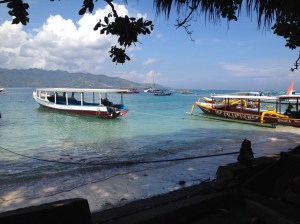 We took a “fast” boat from Bali to the small island of Gili Aire. There are three Gili islands that offer tropical resort living. Our fast boat trip took about five hours each way between the bus ride through traffic choked Bali, waiting for the boat which was late and the hour and a half boat ride. Gili Aire has no motorized traffic so all goods and people are transported by horse cart. We rented bikes and rode around the island in about
 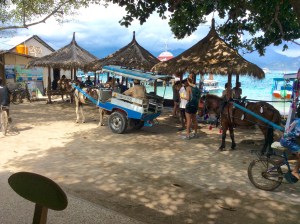 two hours. Our time there included pool-time, snorkeling and as usual sampling exotic foods.
Going Komodo Dragon hunting (with camera) proved to be more complicated than we originally knew. Our choices were to go overland (over 24 hours of bus and ferries across three islands) or a four day/ three night boat ride (small boat with sleeping on the deck) or flying. We found an inexpensive flight and chose to fly directly to the island of Flores.
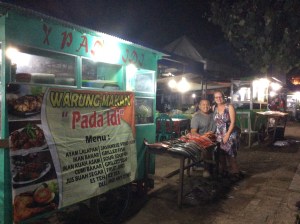 Flores is quite remote. The small village of Labuan Bajo is primarily a launching site for visiting the Komodo Dragons and diving expeditions. Along the one main street are tour operators, dive shops, restaurants and guesthouses. On the ocean front are food stalls selling fresh fish that is cooked over an open fire. We chose a red snapper because it was the one fish we recognized.
Ten of us went on a small boat tour to Rinca Island to find the Komodo Dragons. The Komodos live on four different islands in the area. Although the ones we saw seemed quite docile, they can be very vicious. Komodo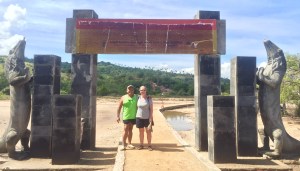 National Park can only be visited with guides who carry long forked sticks as protection in case the Komodos charge. Their bite is deadly as they carry many kinds of bacteria that ultimately kills. Komodos eat every month to six weeks by biting their prey (water buffalo, mule deer or wild boars) and then following them for the several days it takes for the bacteria to kill. They eat the whole animal, bones and all except for the horns and skull. Even though the staff does not feed them we saw several hanging around the cook shack. Those we saw were small and medium sized, there are much larger on the island.


Indonesia is a very welcoming place to visit. We have found Indonesians to be extremely gracious and hospitable. Because Australians have been visiting here for over thirty years, many people speak a little bit of English so communication has been fairly easy. As we walk through the streets, people often say hello and ask where we are going. We have learned to give a simple answers because it is probably all the English they know.
 Travel the World Backpacking
I can’t wait to go to Komodo island later on my Indonesian travels! Check out my blogs on Bali so far