When we took the trip to the salt flats in Argentina, we planned to skip the salt flats in Bolivia because if you’ve seen one salt flat you’ve seen them all, right? Wrong, everyone we met (travelers, tour guides, hostel workers) in Potosi asked if we were going to Uyuni and when we said “no”, they said, “you just have to go”. So, we booked a full day tour to the Salar de Uyuni.
It is the world’s largest salt flat at 4,086 square miles and is located at an elevation of 11,995 feet. The Salar was formed as a result of transformations between several prehistoric lakes. It is covered by several feet of salt crust, which has an extraordinary flatness with the average elevation variation within three feet over the entire area. After the rains, the whole area is covered fairly evenly with about an inch of water giving it an other worldly appearance.


Our first stop on the tour was a train cemetery where old trains from the mines have
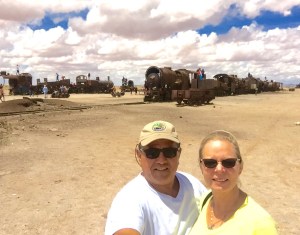 been left to rust. This is a very touristy area. Our guide said that about two hundred SUVs per day are out on the Salar. Many of the tours are for several days with people camping out on the salt flat. There are lodges made out of salt blocks and we saw trailers of bunk beds and port-a-potties. Like many travelers we flew from the rural part of Bolivia to La Paz.


 La Paz is clogged with smog belching traffic (Mike’s theory is that the vehicles don’t have catalytic converters) made up of buses, mini buses and taxis (there are very few private cars). This is a big city but still somewhat primitive and very chaotic. The streets are lined with people selling all manner of products often reducing the streets to a single lane. Couple that with the frequent protests that block the streets and you have constant chaos. When it took us over an hour to make a fifteen minute ride to the Brazilian consulate our taxi driver
  explained it was a “blockque” or blockade caused by the indigenous protesters. The other thing about La Paz is that because of the altitude it is cold even in the summer. We found a English Pub that was warm so we ended up there most evenings. It is the highest capital city in the world at over 12,000 feet in altitude, once again we were breathless as we climbed its steep streets.


On the outskirts of La Paz is Valle de la Luna (Moon Valley). It is an area where erosion has worn away the majority of a mountain, leaving tall spires.


For all the trouble we had getting into Bolivia we only spent twelve days there. The good news is that our visa is good for ten years so we can always go back. We looked forward to heading for the warm beaches of Rio de Janeiro.
 Travel the World Backpacking
One thought on “Bolivia – From the Salt Flats to the Big City”