After finally making it into Bolivia, we walked through the dusty little town of Villazon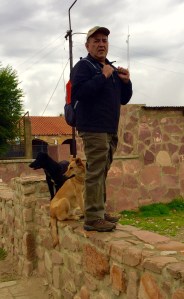 to find a bus to Potosi. As we were walking, Michael jumped up on this wall to take a picture and these two street dogs jumped up to sit with him. In Latin America there are hundreds of street dogs, we have learned not to make eye contact or speak to them because they will follow us and want to be friends.
In Boliva rides in private cars are actually a similar price and much faster than the bus so we shared a car with three others to Potosi. The driver had his wife and baby in the car for the nearly three hour ride so we felt very safe.
“The Silver City”, Potosi is at a very high elevation of 13,400 feet so once again we were breathless everywhere we walked. The city’s history is all about mining and the processing of silver. Cerro Rico (rich hill) has produced silver and minerals for nearly 500 years, making Potosi an important city not only in Bolivia but also in Spain before Bolivia’s independence. There are around 5,000 mines in Cerro Rico with about 4,000 still active. Touring the coin factory where the coins were made, gave us an appreciation of the slave labor (in the mines and the coin factory) used to produce silver coins for Europe. Much of the city’s identity is about the miners, the number who die early and fighting for better conditions.


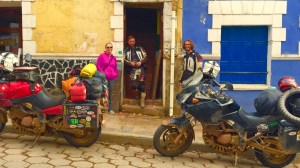 We met these two young men who have driven their motorcycles from Philadelphia and are headed to Terra Del Fuego at the tip of South America. They had some harrowing stories of breakdowns and being hit by a car in La Paz, Bolivia. They described La Paz as a city from the movie Mad Max. At theunknownroads.com, their blog is all about their adventure.
During the middle of the day downtown Potosi has dozens of young people costumed 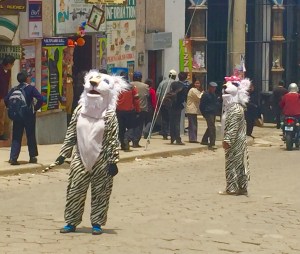 as tigers on every corner directing traffic and helping school children across the street. Until we figured out what they were doing we were wondering why all these tigers were at each corner. We thought maybe it was Carnaval.
When we arrived in Potosi it was during Bolivia’s four-day Carnaval celebration. We missed the parades but many people were still celebrating. Bolivians barbecue meat on open grills for family celebration and then burn paper shapes representing sacred objects as a sacrifice. Young people ride around in the back of pickup trucks throwing water and colored powder on unsuspecting people passing by. Carnaval in Bolivia is folkloric in nature rather than the flash of Brazilian Carnaval.


 Travel the World Backpacking
One thought on “The Silver City of Potosi Boliva”